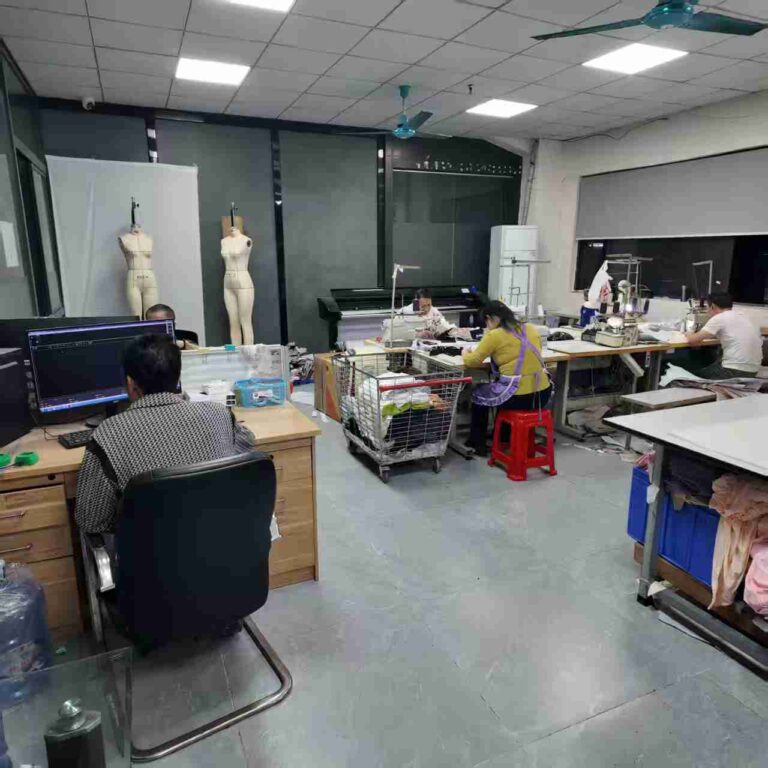

Darmax at a glance
| Minimum order | From 30 pieces per style |
| Sampling | 7 to 10 days |
| Bulk production | 20 to 30 days |
| Factory certification | SGS certified |
| Certified fabrics | GRS, GOTS, OEKO-TEX available |
For a new apparel brand, a workable minimum order quantity starts from 30 pieces per style. That is the range where you can test a design on real customers without tying up your entire budget in inventory. Our own minimum starts from 30 pieces per style, depending on the style.
If you have been quoted 1,000 pieces as a starting point, you are talking to a factory built for a different kind of customer. That is not a negotiation problem, it is a mismatch. This guide explains why the numbers differ so much, and what to look for at each stage of your brand.
What does MOQ actually mean in apparel manufacturing?
MOQ stands for minimum order quantity: the smallest number of units a factory will accept for a single production run.
The detail most buyers miss is the unit of measurement. A factory quoting “500 pieces” usually means 500 pieces per style, per colour. Two colours of one hoodie design is 1,000 pieces. Three sizes split across two colours multiplies again. Always confirm the unit before you compare quotes, because a 300 piece MOQ per colour can end up requiring more units than a 500 piece MOQ per order.
Why do large factories set MOQ at 500 or 1,000 pieces?
It comes down to how a production line is set up, not to any desire to exclude small brands.
A cut and sew line has fixed costs each time it starts: the cutting table is laid up, the pattern is graded, the sewing line is balanced, trims are sourced against a minimum purchase, and the fabric is dyed in a single lot. Once that setup is done, adding units is cheap. So a factory makes its margin on long runs, and a 50 piece order consumes the same setup time for a fraction of the revenue.
Some factories also buy fabric in rolls with their own minimums, which sets a floor on how small an order they can physically take on.
What MOQ should you look for at each stage of your brand?
| Your stage | What you need | Workable MOQ |
|---|---|---|
| Validating a design | A sample you can touch and photograph | 1 sample unit |
| Testing the market | Enough stock to sell and measure demand | From 30 pieces per style |
| Proven best seller | Reorders before you run out | 100 to 500 pieces per style |
| Scaling a winner | Unit cost reductions | 1,000 pieces and above |
The mistake we see most often is a brand spending its whole launch budget on one size of order because a factory pushed them up to a volume they were not ready for. Launching three styles at 30 pieces each will teach you more than launching one style at 300.
What happens if you order below a factory’s MOQ?
Three things typically happen, and only one of them is useful to you.
- They decline. This is the clean outcome. It tells you the fit is wrong before you invest time.
- They accept but add a surcharge. A low quantity surcharge is common and can be legitimate, but it should be quoted up front and not buried in the unit price.
- They accept, then deliver late. The worst outcome. Your small order is queued behind every large order in the factory, and your launch date slips. Ask directly what queue position a small order gets.
Does a low MOQ mean lower quality?
No, and it is worth being precise about why.
Quality is determined by the fabric specification, the pattern accuracy, the operator skill, and the inspection standard applied. None of those change with order size. What changes is setup efficiency. A factory can run the same four-stage quality control and the same AQL inspection standard on 30 pieces as on 30,000.
The real risk with a small order is fabric, not sewing. Small orders are often made from stock fabric rather than a custom dye lot, so if you need an exact Pantone match, confirm the fabric availability before you commit to the design.
How do you test a factory without committing to volume?
Use a two step approach that costs very little.
Step one, a sample. Send your tech pack and get one sample made. This tells you how accurately they read your specification, how they handle a revision round, and how fast they communicate. A factory that is slow or vague during sampling will be worse during production.
Step two, a small production run. Once the sample is approved, place 30 to 100 pieces. This is where you learn what sampling cannot tell you: consistency across units, packaging, labelling, and whether the delivery date holds. We develop samples in 7 to 10 days and run bulk production in 20 to 30 days, so a full test cycle finishes inside six weeks. The inspection standard we apply on that run is set out in ISO 2859-1.
Frequently asked questions
What is a normal MOQ for custom clothing manufacturing?
Most established garment factories set their minimum order quantity between 500 and 1,000 pieces per style and colour. Factories built for new brands start lower, typically between 30 and 100 pieces.
Why is the MOQ so much higher at large factories?
Because their cost structure is built around volume. Cutting tables, dye lots and assembly lines are set up for long runs, so switching a line over to a small order costs them nearly as much as a large one.
Does a low MOQ mean lower quality?
No. Quality comes from the manufacturing process, the fabric you choose and the inspection standard applied, not from the order size. A factory can apply the same four-stage quality control to 30 pieces as to 30,000.
How do I test a factory without placing a large order?
Start with a sample, then a small production run of 30 to 100 pieces. This tests their pattern accuracy, fabric sourcing, communication speed and quality control at a fraction of the risk of a full order.
If you want to see how a small order would actually be quoted for your design, send us your tech pack through the quote form and we will come back with MOQ, sampling time and a production schedule.
Related reading: how our sample development process works and choosing between a Chinese and a Vietnamese manufacturer.